

If you’ve been in the football betting world for a while, you’ve definitely found yourself at a major crossroads: is it better to analyze a match with a clear head and place your bet before kickoff? Or is it better to do it while the action is unfolding?
Let’s be completely honest, I have a clear preference and I make no secret of it: I much prefer operating on live markets.
However, in betting, there are no absolute truths that apply to everyone. That’s why in this article, I won’t just tell you what I do, instead, we are going to break down the pros and cons of both approaches in detail.
A while ago, we tackled a structural dilemma by comparing Betting Exchange vs Bookmakers: once you understand where to move and protect your money, the next logical step is when.
Choosing your timing will radically change your routine, your risk management, and above all, your results.
Indice
Stop "playing" and start "operating" in betting
In the title of this post, I intentionally used the word “playing” because it’s the term that 99% of people use, but if you intend to get serious, you must immediately erase it from your vocabulary.
Anyone who approaches football betting with the goal of generating a consistent long-term profit is not playing.
Gambling is a recreational dynamic linked to luck; what we do is a true financial operation based on searching for positive expected value (+EV).
This shift requires a deep mindset change: if you keep watching a match through the eyes of a fan or a casual bettor, you will always remain the perfect customer for the bookmakers.
To reverse this course and stop giving money away to the house, you need to develop the right sports investor mindset. Only by treating your bankroll as capital to preserve and grow will you be able to make that leap in quality.
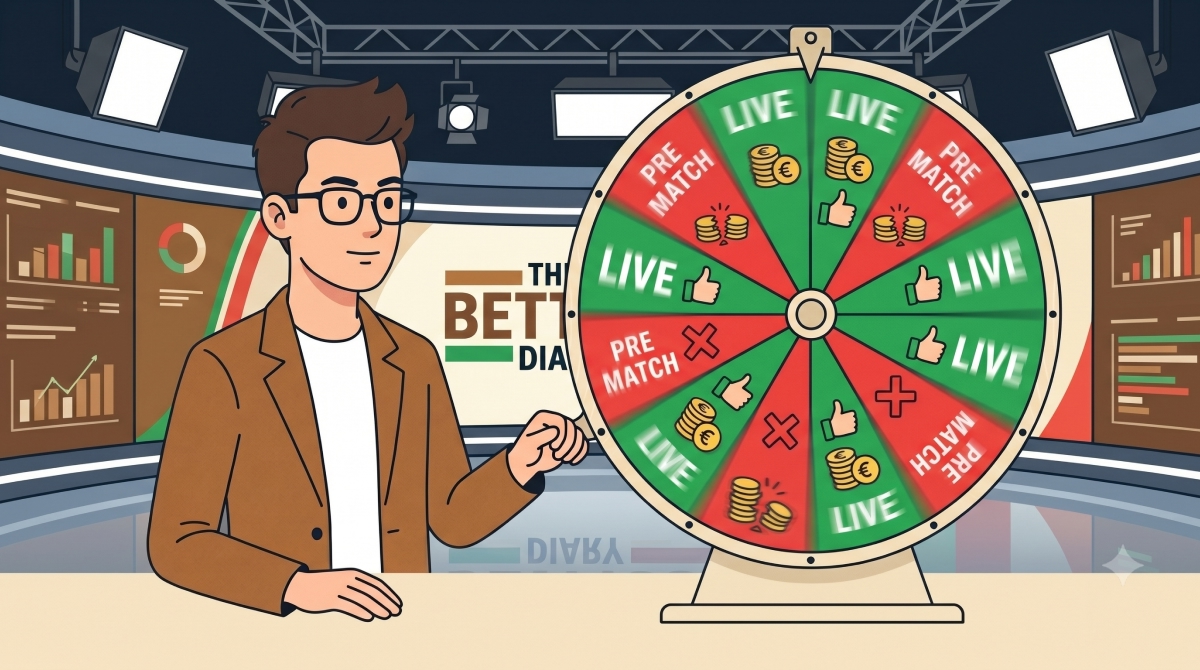
Pre-Match vs Live Football: The battle of data (hypothesis vs reality)
The dividing line between the pre-match and live markets essentially comes down to a matter of data.
Specifically, we are talking about the difference between a theoretical assumption and the reality unfolding on the pitch.
Pre-Match and bookmaker odds: an almost perfect market
When you decide to invest in pre-match betting, you are moving within a market that verges on mathematical perfection.
Bookmakers have terrifyingly powerful predictive algorithms and, even more importantly, they have all the time they need to fine-tune odds, correct anomalies and eliminate their mistakes before kickoff.
At this stage, your analysis is inevitably based on a static snapshot: historical statistics, motivations, probable lineups, expected weather conditions, etc.
Don’t get me wrong, this is all excellent information, but they still remain mere hypotheses and assumptions.
Finding a clear competitive edge over the odds calculated by oddsmakers before the match is an extremely difficult task, because they rarely make glaring mistakes before kickoff.
Live betting: when another sport begins
At kickoff, however, that almost perfect market suffers a shock.
The theoretical pre-match assumptions give way to the reality of the ninety minutes and this is where, in many ways, a completely different sport begins.
Concrete variables like the intensity of the game’s pace, a sudden shift in psychological momentum, a red card, or an unexpected injury turn the scenario upside down in fractions of a second.
In live betting, data changes continuously and frantically.
This constant volatility puts enormous pressure on bookmakers’ software, which must recalculate probabilities in real time as events happen.
For a quantitative bettor like me, this controlled chaos is a godsend: it’s precisely in these moments that the best value windows open up, meaning situations where the offered odds do not reflect the actual flow of the match at that exact moment.
How live betting works and why "Time" is your best ally
To move profitably in this environment you must understand the deep mechanisms regulating real-time odds movements.
Many amateur bettors believe that odds only move when there is a goal, a red card, or a dangerous shot.
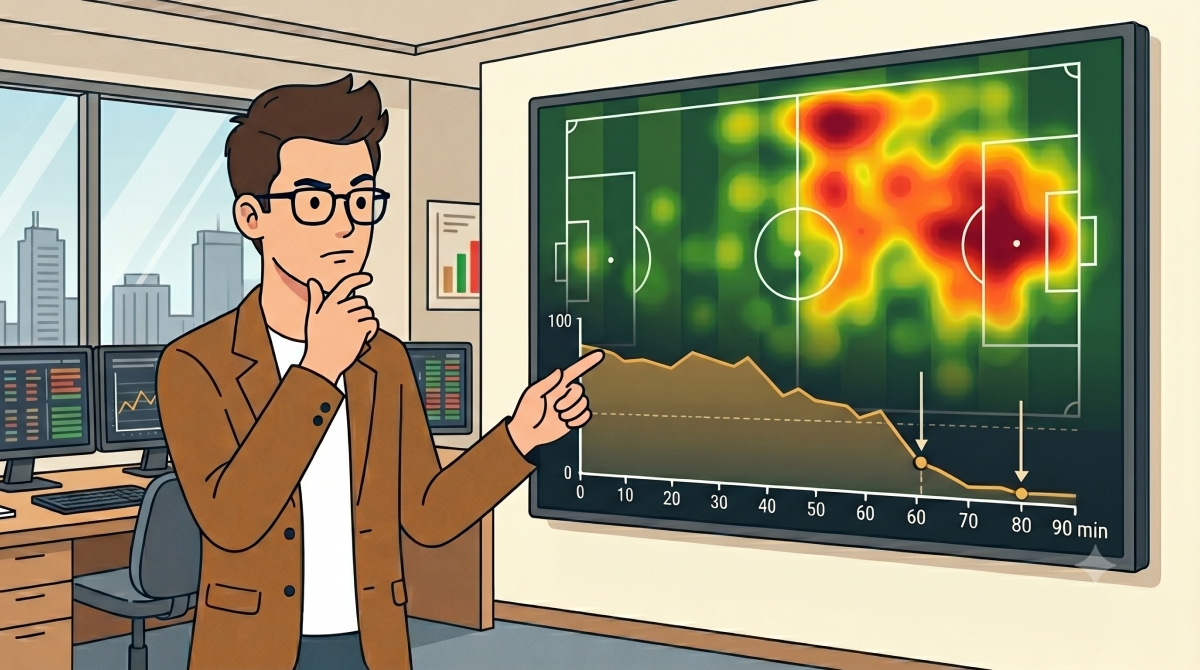
The mathematical reality is very different: the main driver shaping live markets is the passage of time, a phenomenon known as time decay.
Think of a live football bet as an hourglass: the passing of the minutes exerts a constant and predictable pressure on the odds.
Bookmakers’ software is inextricably linked to the mathematical models set pre-match, meaning they cannot arbitrarily distort or warp live lines; otherwise, they would create glaring inconsistencies and market asymmetries that professionals would instantly exploit for “surebets” or arbitrage.
Time, as a result, becomes your most valuable ally.
By patiently waiting for the passing minutes to inflate/deflate specific odds, you can enter the market capturing an extraordinarily favorable risk/reward ratio, impossible to replicate before kickoff.
The price to pay in live betting: understanding the bookmaker's margin and odds calculation
At this point, the live approach might seem like a panacea for all ills, but in reality, like any financial strategy, it also comes with an entry cost.
Bookmakers are certainly not charities; they know very well that they are vulnerable during live matches and protect themselves by raising their defenses.
In live sports betting, this shield is always called the bookmaker’s margin (meaning the overround or the profit margin that the bookmaker keeps on every market), and it is significantly higher compared to the pre-match market.
If you want to make money from betting, you must know how to calculate this hidden cost.
An apparently tempting odd can turn out to be a trap if the bookmaker’s overround is too heavy, as that margin will erode your profitability in the long run.
If you still have doubts about what the bookmaker’s margin is, how exactly betting odds are calculated, or what 10-to-1 odds mean in practice, I suggest you pause for a moment and take a step back. We have thoroughly analyzed these mathematical concepts in a cornerstone article on our blog, openly explaining whether making money with sports betting is still possible, precisely in light of these bookmaker defenses.
Live vs Pre-Match football betting: my definitive choice as a quantitative bettor
Despite the mathematical disadvantage of a higher bookmaker margin, live betting remains my preferred tool for extracting profit.
The reason lies in a purely quantitative and financial logic, tied to two major advantages that the pre-match approach can never offer.
The first advantage is generating high betting volumes.
In pre-match, you are bound by the rigidity of the starting odds: once you analyze the schedule, real mathematical value opportunities are numerically limited. In live betting, however, the relentless fluctuation of markets tied to match events creates an industrial amount of micro-opportunities.
A quantitative investor monitoring operational flows can execute a significantly higher number of market entries, increasing the frequency of value bets and accelerating bankroll growth.
The second aspect, often underestimated, concerns the reduction of cash exposure, known in finance as Capital Turnover.
When you place a pre-match bet, you are forced to tie up your liquidity many hours before the event, sometimes even days.
For all that time, your money is locked up and “at risk“.
In live betting, you can apply a surgical strategy: for instance, if you enter an Over line in the last twenty minutes of a match and a goal is scored after just three minutes, the operation closes instantly.
The profit is credited immediately to your account, and that capital becomes instantly available to be reinvested in the next match.
| Operational Parameter | Pre-Match Approach | Live Approach |
| Nature of data | Static (hypotheses, historical data, assumptions) | Dynamic (real-time statistics from the pitch) |
| Bookmaker Margin (Overround) | Lower | Higher (the house protects itself more) |
| Value windows (+EV) | Rare and hard to identify | Frequent, generated by the time factor |
| Capital turnover | Slow (money locked up for hours or days) | Lightning fast (capital freed up in minutes) |
| Time and focus required | Reduced (analysis can be planned in advance) | Maximum (requires presence and execution speed) |
Let’s be clear, operating live is no walk in the park.
It’s an approach that requires a significantly higher level of discipline compared to pre-match (though methods exist to simplify these aspects too, which I might cover in future articles).
Yet, if the ultimate goal is to make real money by exploiting real-time data and bypassing the bookmakers’ ironclad mathematical models, live football betting remains, in my opinion, the best path forward in today’s market.
It is the more complex path, but it’s also the one that pays off the most in the long run.