

Can you make money from betting and, in more structured cases, get rich with betting? The short answer is yes, but not in the way you’ve been conditioned to think on social media.
You won’t get rich in a weekend starting from €20 with double-up accumulators on Telegram. Earning consistently is only possible by transforming betting into a financial asset based on mathematical models with positive expected value, scientific capital management (money management), and cold emotional stability.
We have already answered the question of whether it is still possible to make money with sports betting now it’s time to dive into the mathematical and operational details: how much can you actually earn from this world and how does this activity differ from traditional investments?
Indice
The fatal psychological error: why if you don't know how much you want to earn, you've already lost
The fundamental difference between a traditional bet and an investment lies in the planning of objectives.
Most people approach the betting market with a vague idea: “I want to make as much money as possible”.
This is the first step toward failure.
If you don’t know from the start how much you want to earn (and how much you can afford to lose), you’ve already lost from the start.
The absence of a numerical and professional target destroys the average bettor due to two psychological dynamics:
- The FOMO trap (Fear of Missing Out): fueled by fake screenshots of massive winning bet slips and luxury lifestyles published by fake tipsters on social media. This distortion creates the illusion that everyone is making millions except you.
- Perpetual dissatisfaction: If you don’t have a macro objective, you could close a month with an excellent +20% on capital and still feel “poor” or dissatisfied because you didn’t change your life in thirty days. That dissatisfaction will push you to over-expose yourself, increase the odds, and, inevitably, blow your account.
Defining a realistic financial target even before placing your first bet is the only shield against emotion.

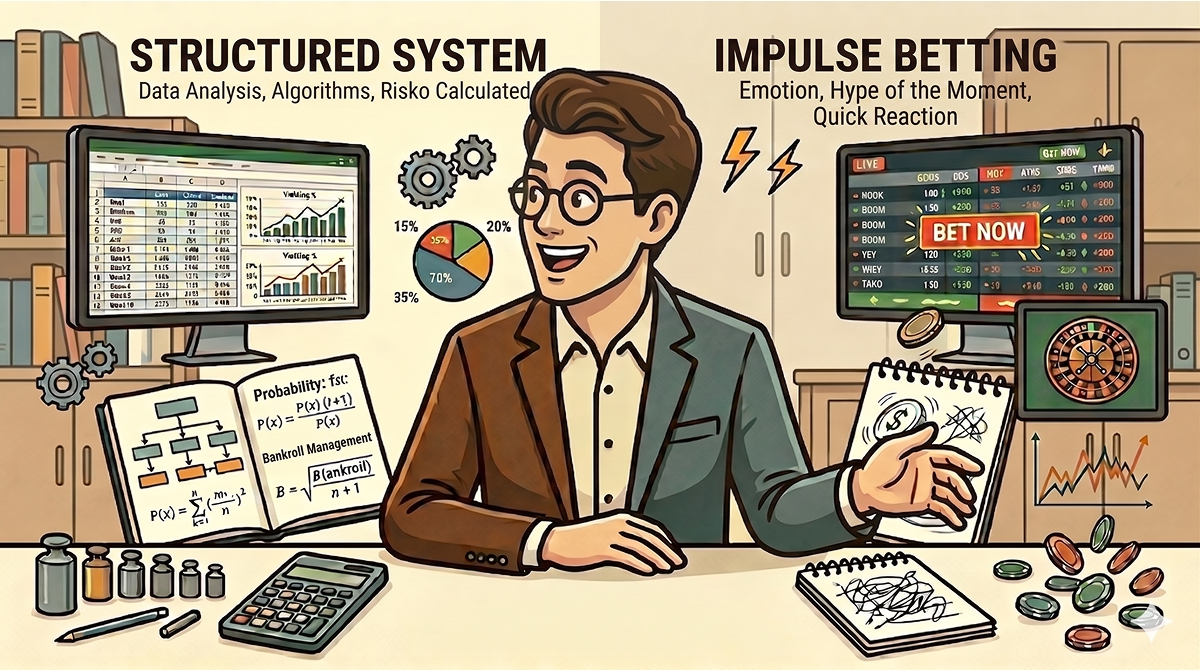
Predicting earnings: structured systems vs impulse play
To understand if you can make money from betting, you need to stop looking at profits in absolute monetary terms.
Profit in professional betting is always and only calculated as a percentage (%) of the initial bankroll, never in absolute euros.
Thinking about earning €1,000 a month starting from a €1,000 bankroll means chasing a mathematically unsustainable miracle in the long term, which requires exposure to destructive variance.
Generating the same €1,000 operating on a €10,000 bankroll is pure administration, risk management, and professionalism.
To successfully predict earnings and extract money from bookmakers, you cannot rely on intuition or impulse play. You must move exclusively on structured systems that boast a certified history.
In professional betting, you reason using precise metrics:
- EV+ (Positive Expected Value): value betting algorithms that systematically identify higher odds compared to the actual statistical probability of the event occurring. Only by moving within the EV+ asset does math side with you in the long term.
- ROI (Return on Investment): the total return generated on the initial capital.
- Yield: the average percentage profit generated on every single euro invested (the betting volume or turnover).
Starting to master these terms will give you a much more complete understanding of the game, limiting the temptation to make impulse plays, which is the ruin of every bettor.
Professional betting vs classic bank investment: risk management
Many try to draw a simplistic parallel between betting and traditional financial markets, but there is a fundamental difference to mark on the risk management front.
An annual return of +10% in the bank (through a good equity ETF or investment funds) is considered an excellent result. In professional betting, an annual +10% is a management failure.
Why? Because of the risk premium (risk premium).
In sports betting, the risk level is significantly higher than a deposit account or a global ETF. You have to deal with brutal variance, physiological drawdown periods (consecutive loss phases) and, above all, account restrictions implemented by bookmakers as soon as you start to be profitable.
Since the operational and capital risk is much higher, the expected return must be much higher.
For example, the S&P500 index (which has always been one of the most profitable) returns just under 10% a year on average, but the fact that it has done so for over 50 years is an enormous value, which we do not have in the world of sports investment.
Therefore, little historical data means only one thing: greater risk.
You cannot and must not settle for bank crumbs if you are risking your capital with bookmakers: the target must reflect the efficiency of your mathematical strategies.
Here is how the two worlds compare:
| Characteristic | Classic bank investment (e.g., ETFs/Government bonds) | Professional sports betting (Betting As An Asset) |
| Expected annual return | On average 4% – 10% on capital | Over 50% on capital |
| Risk level | Low to moderate | Very high (margin, drawdown, variance, restrictions) |
| Expertise required | Passive (an accumulation plan is enough) | Very high (mathematical analysis, emotional management, markets) |
| Predictability | Stock/bond market history existing for over 50 years | Very few bettors with a positive track record of over 10 years |
How much does a professional bettor earn? Let's do the math
Answering precisely how much a professional bettor earns is extremely complex.
On the web, transparency is a rare commodity: there are very few alleged professional tipsters who truthfully publish their balance sheets and, above all, almost no one possesses a verified track record certified by third-party platforms that exceeds 5 years.
Real earnings do not depend on a magic formula, but on the size of the bankroll and the efficiency of the systems adopted.
A professional with a €100,000 bankroll and a stable Yield of 4-5% on large volumes can generate tens of thousands of euros a year. Anyone operating with €5,000 will produce proportionally lower figures, while maintaining the exact same mathematical excellence.
As you will have understood, therefore, the bankroll makes a big difference.
To a lesser extent compared to classic bank investment, but it still does.
Personally, since one of my core beliefs is that quantity is more important than quality, Yield is a parameter that I keep monitored but that interests me only to a certain extent.
ROI, on the other hand, is the most important parameter for me, and my goal is to have around an average of +10% monthly.
An annual +100%, which means a doubling of capital, with a 4/5% Yield is something I consider to be really, really impressive.

Transparency is the most important metric in this industry
Ultimately
Treating betting as a financial asset requires a total paradigm shift.
It is not about guessing who will win tonight’s match, but about applying statistical models, managing the bankroll with scientific rigor, and accepting operational risk in exchange for returns potentially uncorrelated with traditional markets.
If you don’t have the patience to build a path based on mathematics, the bookmaker will always have the upper hand.
Frequently Asked Questions (FAQ)
Is it possible to make money from betting consistently?
Yes, it is possible if you stop betting on impulse and apply positive expected value (EV+) strategies, such as value betting supported by ironclad capital management and a certified data track record.
What is the difference between a bet and an investment?
The fundamental difference lies in the management of expected value and risk. While a traditional bet is an impulse act with a negative expected value for the player, investment (even in betting) is based on a structured and replicable mathematical advantage in the long term.
How much does a professional earn from betting?
Earnings are not a fixed figure but are strictly proportional to the starting bankroll and the Yield of the systems used. A professional thinks in terms of annual percentage return on capital, which in this market must significantly exceed bank returns to justify the operational risk.